Build a simple morning routine after 40 that supports strength, weight loss, energy, and consistency without waking at 5 a.m. or creating more pressure.
Morning routines have become strangely competitive.
Wake up at 4:45.
Drink lemon water.
Meditate.
Journal.
Stretch.
Read ten pages.
Take supplements.
Walk ten thousand steps.
Make the perfect breakfast.
Cold plunge.
Plan your entire day.
And somehow complete all of it before anyone else in the house wakes up.
For a woman already carrying work, family, relationships, health goals, and a body that may not sleep as predictably as it once did, that kind of routine can feel less like self-care and more like another job.
You do not need that.
A useful morning routine after 40 should make the rest of your day easier.
That is the standard.
Not whether it looks impressive.
Not whether an influencer would film it.
Not whether it takes ninety minutes.
The Fire & Grace approach is much simpler:
Wake your body up.
Give it what it needs.
Decide what matters today.
Then get on with your life.
That can happen in fifteen minutes.
It can happen in forty-five.
And on some mornings, the minimum version may take five.
The routine is not the goal.
The life it supports is.
A Morning Routine Will Not Cause Weight Loss by Itself
Let's get this out of the way first.
There is no special morning habit that melts abdominal fat.
Drinking water at 7 a.m. does not create fat loss by magic.
Neither does walking before breakfast.
Neither does lemon water.
Neither does delaying breakfast.
Neither does eating breakfast immediately.
Weight loss still depends on your larger pattern of nutrition, movement, sleep, training, and energy balance over time.
So why bother with a morning routine?
Because mornings influence behavior.
A morning that begins with no plan, little food, poor hydration, and immediate stress can make the rest of the day harder to manage.
A morning with a little structure can make supportive choices easier.
That is its value.
The routine is not a metabolism hack.
It is a decision-making tool.
Start by Dropping the Fantasy Version
Before building your morning routine, forget the version of you who has unlimited time.
Build it for your actual life.
If you normally wake at 7:30, do not create a routine that requires you to wake at 5:00 unless you genuinely want to.
If you already struggle with sleep, sacrificing another hour to perform a wellness routine may be counterproductive.
If mornings are hectic, create a shorter routine.
If you work from home, maybe yours can be longer.
If you commute, perhaps your routine needs to fit between getting dressed and getting out the door.
A sustainable morning routine begins with the schedule you actually have.
Not the one you wish you had.
The First Question: What Does My Morning Need to Accomplish?
Not every woman needs the same routine.
Your morning may need to help you:
Feel less rushed.
Eat enough protein.
Remember your workout.
Get outside.
Drink water.
Reduce phone scrolling.
Take medication.
Prepare for a demanding workday.
Create ten quiet minutes before everyone needs something.
You do not need to solve every health goal before 9 a.m.
Choose the few things that create the most leverage.
If better mornings make your nutrition, movement, and stress easier later in the day, the routine is working.
The Fire & Grace Morning Framework
A simple Fire & Grace morning can be built around four anchors:
1. Wake the body
A small amount of movement, daylight, or simple physical activity helps shift you from sleeping to participating in the day.
2. Nourish the body
Hydrate and eat in a way that supports your hunger, energy, and protein needs.
3. Orient the mind
Look at the day before the day begins making decisions for you.
4. Protect one priority
Identify one action that supports your strength, health, or well-being and give it a place.
That is enough.
You can build more around those anchors if you enjoy it.
But you do not have to.
Step One: Get Some Light and Movement
You do not need a full workout first thing in the morning.
You simply need to wake up your system.
Open the blinds.
Step outside.
Walk to the mailbox.
Take the dog around the block.
Move through a few shoulder circles and hip movements while coffee brews.
Walk on the treadmill for five or ten minutes.
The purpose is not calorie burn.
It is transition.
You spent several hours horizontal and asleep.
A little movement reminds your body that the day has started.
If morning walking works well for you, wonderful.
If you prefer evening walks, keep them in the evening.
Morning is not morally superior.
The best time to move is the time you will actually repeat.
You Do Not Have to Exercise Before Breakfast
Fast morning workouts work well for some women.
Others feel weak, shaky, nauseated, or simply miserable.
There is no medal for suffering through a workout because someone online said fasted cardio burns more fat.
If you like training before breakfast and perform well, fine.
If you need something first, eat.
A banana.
Greek yogurt.
Toast.
A small protein shake.
Whatever supports the training.
Your workout should be organized around performance and consistency, not an arbitrary rule about what time food is allowed.
Step Two: Hydrate Without Turning Water Into a Religion
You have gone several hours without drinking.
Having some water in the morning is a reasonable habit.
That does not mean you need to chug a gallon before coffee.
Have a glass.
Keep water nearby.
Drink during the morning.
Move on.
You also do not need to add lemon, salt, cayenne pepper, vinegar, chlorophyll, collagen, or anything else unless you genuinely want it or have a specific reason.
Water is still water.
Health does not have to become a chemistry experiment.
Yes, You Can Have Coffee
Coffee does not cancel your healthy morning.
If you enjoy it and tolerate it well, drink it.
The question is what happens around it.
Does coffee replace breakfast even though you are hungry?
Does one cup become four because you are exhausted?
Does the coffee contain enough cream and sugar to function as a small dessert without you realizing it?
Does caffeine late in the morning or afternoon interfere with your sleep?
Those are useful questions.
Coffee itself does not need to become another food rule.
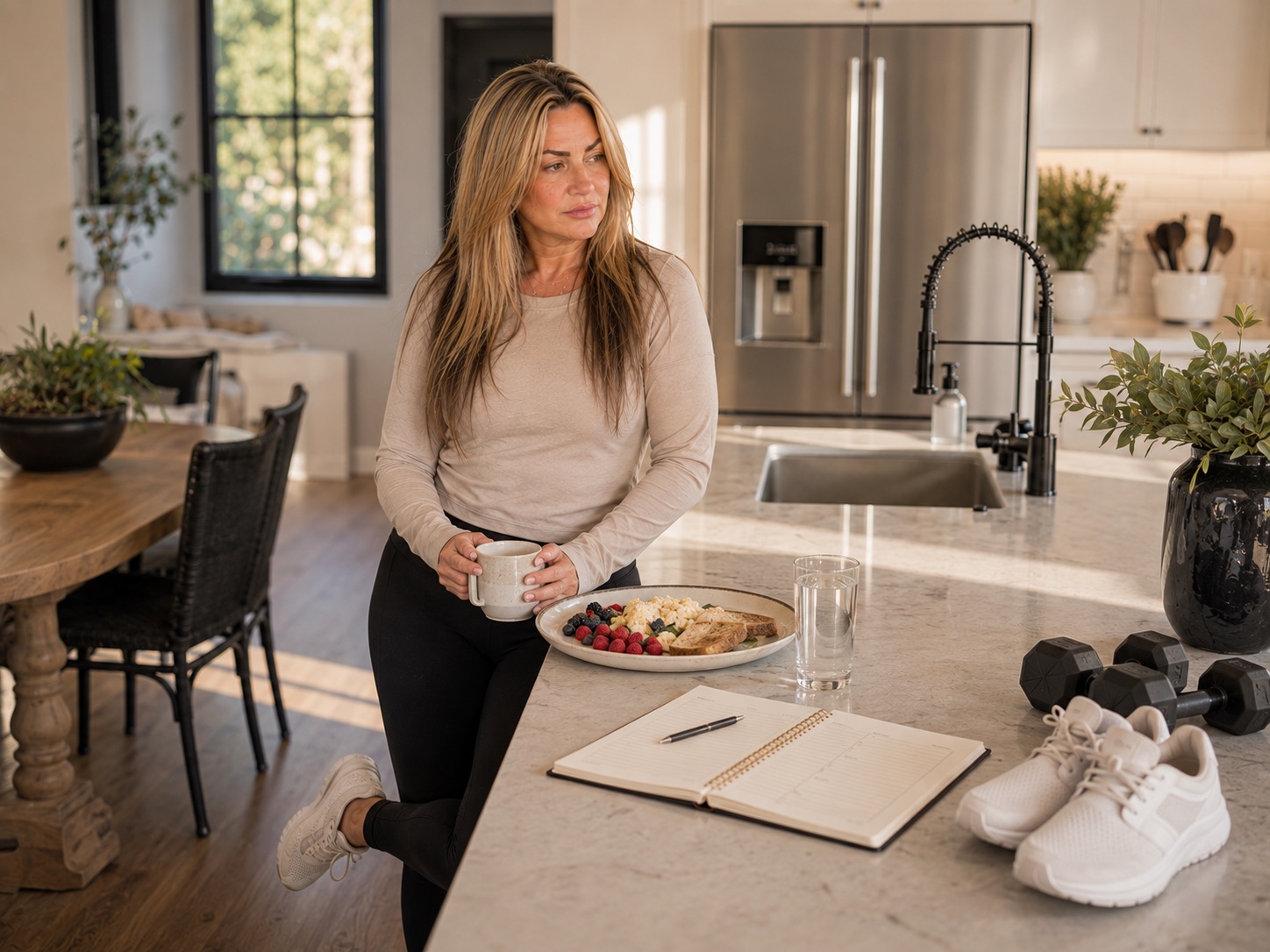
Step Three: Make Protein Easy Early
One of the most useful morning changes for many women is simply becoming more deliberate about protein.
Not because breakfast has magical fat-burning properties.
Because getting meaningful protein earlier can make it easier to reach an adequate amount across the entire day.
If breakfast is coffee and toast, you have a lot of catching up to do later.
If breakfast includes eggs, Greek yogurt, cottage cheese, tofu, turkey, or another protein-rich food, the day starts differently.
You do not need a bodybuilding breakfast.
You need something useful.
What Does a Protein-Rich Breakfast Look Like?
It can be simple.
Eggs with toast and fruit.
Greek yogurt with berries and oatmeal.
Cottage cheese with fruit and toast.
Eggs and potatoes.
A breakfast sandwich with egg, cheese, and turkey.
A protein shake with fruit when you are rushing.
Leftover chicken and rice if that sounds good to you.
Breakfast food is just food eaten in the morning.
You are allowed to eat something unconventional if it works.
You Do Not Have to Eat Breakfast If You Are Not Hungry
This is another place where rigid advice fails.
Some women wake up hungry.
Others do not.
If you are genuinely not hungry and feel good waiting, you do not have to force a large meal the moment you open your eyes.
But pay attention to what happens later.
Does skipping breakfast work well for you?
Or does it lead to being ravenous at noon, grazing all afternoon, and feeling out of control at dinner?
Your pattern matters more than the label.
Use the eating schedule that helps you feel and perform well across the entire day.
Build Breakfast With the Fire & Grace Plate Method
Even breakfast can use the same basic structure.
Protein.
Produce.
Carbohydrate.
Fat or flavor.
You do not need every category in perfect proportions.
For example:
Eggs, toast, berries, and avocado.
Greek yogurt, fruit, oatmeal, and nuts.
Eggs with potatoes, peppers, and cheese.
A protein shake, banana, and peanut butter.
The point is to create a meal that actually holds you.
Not a tiny “diet breakfast” that leaves you thinking about food ninety minutes later.
Step Four: Look at the Day Before the Day Takes Over
You do not need a complicated productivity system.
Look at your calendar.
What is happening today?
When are you working out?
When will lunch happen?
Are you eating out tonight?
Do you have a late meeting?
Will you be driving through the time you normally eat?
Is today going to be unusually stressful?
This two-minute review matters because many “bad choices” are simply unplanned circumstances.
You do not need more discipline at 4 p.m.
You may need to know at 8 a.m. that 4 p.m. is going to be difficult.
Protect One Physical Priority
Choose one thing related to your body that matters today.
Maybe it is:
Strength training at 6:00.
A twenty-minute walk at lunch.
Eating a real lunch instead of working through it.
Getting to bed earlier.
Drinking less alcohol tonight.
Taking ten minutes for mobility.
Write it down.
Put it on the calendar.
Set out the shoes.
Pack the gym bag.
Do something that moves the priority from intention into the physical world.
The more decisions you make in advance, the less the tired version of you has to negotiate later.
If Strength Training Happens Later, Prepare for It Now
This is a small habit with a surprisingly big payoff.
If you plan to train after work:
Pack the bag.
Set out your clothes.
Put your shoes where you will see them.
Know which workout you are doing.
Confirm the time.
If dinner needs to be easier afterward, know what dinner will be.
You are reducing friction.
Motivation is helpful.
Friction is powerful.
Make the desired behavior easier to begin.
You Do Not Need a 30-Minute Journal Practice
Journaling can be useful.
It can also become another item on a wellness checklist that people force themselves to do.
If you love journaling, great.
If you do not, skip it.
A useful mental check-in might be three sentences:
What matters today?
What do I need today?
What am I not going to make harder than it needs to be?
That can take sixty seconds.
The objective is awareness.
Not producing a publishable diary entry.
A Morning Routine Should Reduce Mental Noise
You do not need to begin the day by consuming everyone else's thoughts.
This is worth considering.
How soon after waking do you reach for your phone?
Email.
News.
Social media.
Messages.
Work notifications.
Before your feet hit the floor, you may already be responding to other people's priorities.
You do not need an hour-long digital detox.
Try ten minutes.
Or twenty.
Let your first interaction be with your own body and day before the rest of the world enters.
You might be surprised how different that feels.
Do Not Start the Day by Looking for Something Wrong With Your Body
Some women wake up and immediately evaluate themselves.
Stomach.
Scale.
Mirror.
Face.
Bloating.
Clothes.
The morning becomes an inspection.
That creates a strange emotional tone for the rest of the day.
If weighing regularly is useful to you, weigh.
Record the number.
Let it be information.
You do not need a commentary track.
Yesterday's sodium, digestion, training, hormones, and fluid balance can influence the scale.
One number does not deserve to control your mood before breakfast.
If You Weigh Yourself, Use the Trend
The scale can be useful for some women.
It can also become an emotional alarm.
If you choose to weigh regularly, use a trend rather than reacting to individual readings.
You may be up today.
Down tomorrow.
Flat for several days.
That is normal.
Your job is not to respond to every number.
Your job is to observe the direction over time.
Do not redesign your diet because Tuesday morning was weird.
Your Morning Routine Does Not Need a Cold Plunge
You can take one if you love it.
You can also simply take a shower.
There is a larger lesson here.
Do not confuse novelty with necessity.
Fitness and wellness culture constantly produce new things for you to add.
Morning powders.
Breathing protocols.
Ice baths.
Light devices.
Supplements.
Special drinks.
Apps.
Wearables.
Some of these tools may be useful.
None of them replaces the boring fundamentals.
Sleep.
Food.
Protein.
Strength training.
Walking.
Cardiovascular exercise.
Medical care.
Recovery.
Boundaries.
Build the base before accessorizing it.
The Best Morning Routine Supports Your Evening
This may sound backwards.
But one of the best uses of your morning is making tonight easier.
What time do you need to stop working?
What is dinner?
Do you need to thaw something?
Are you training?
When will you realistically be home?
What time do you need to begin winding down for sleep?
A strong morning routine does not simply create a productive morning.
It creates a more intentional day.
Morning Routines Can Support Weight Loss Through Fewer Emergency Decisions
Think about the situations that often derail nutrition.
You skip breakfast.
Work through lunch.
By 3 p.m., you are ravenous.
You grab whatever is available.
Work runs late.
You have no plan for dinner.
You order takeout.
You eat quickly because you are starving.
Then you crave something sweet afterward.
That entire chain can begin early.
Now imagine a different version.
You eat a reasonable breakfast.
You know lunch is packed.
You see the late meeting on your calendar.
You plan a snack.
Dinner is simple because you knew the evening would be tight.
Nothing there is dramatic.
But the day requires far fewer emergency decisions.
That is how morning structure can indirectly support weight loss.
You Do Not Need to Meal Prep Your Entire Life
Your morning can include small food preparation without turning Sunday into a seven-hour cooking marathon.
Pack Greek yogurt.
Take fruit.
Put leftover chicken and rice in a container.
Grab a protein shake.
Prepare a sandwich.
Take nuts.
You do not need twenty identical containers lined up in your refrigerator to be prepared.
Prepared means future-you has an easier option.
That is enough.
Make Convenience Work for You
Convenience foods are not automatically unhealthy.
Frozen vegetables.
Microwavable rice.
Rotisserie chicken.
Pre-cut fruit.
Bagged salad.
Greek yogurt.
Cottage cheese.
Pre-cooked eggs.
Ready-to-drink protein shakes.
Simple frozen meals.
These can make a full life easier.
Your morning routine does not need to demonstrate culinary excellence.
It needs to help you eat.
Your Morning Routine Should Survive a Bad Night of Sleep
This is especially important in midlife.
There may be nights when sleep does not cooperate.
Hot flashes.
Stress.
Restlessness.
A partner snoring.
Work on your mind.
You wake up depleted.
That day needs a different version of the routine.
Do not force the full routine just because it is written down.
Use the minimum.
Water.
Food.
Medication if applicable.
Look at the day.
Decide whether the workout needs modification.
Go.
A routine that only works after perfect sleep will not be useful every day.
Create Three Morning Settings
This is one of the simplest Fire & Grace tools.
Green Morning
You slept reasonably well and have time.
You may:
Drink water.
Move for ten or twenty minutes.
Eat breakfast.
Review the day.
Prepare lunch.
Maybe train if mornings are your preferred workout time.
Yellow Morning
You are rushed or tired.
You may:
Drink water.
Grab a protein-rich breakfast.
Look at the calendar.
Pack what you need.
Get moving.
Red Morning
Life exploded.
You overslept.
You barely slept.
Something urgent happened.
The routine becomes:
Take care of immediate needs.
Eat something when you can.
Do not turn chaos into a moral failure.
Return tomorrow.
The existence of a red morning does not cancel the system.
It is part of the system.
Morning Walking Can Be Powerful Because It Is Easy to Protect
If you struggle to accumulate movement during the day, a short morning walk can be valuable.
Not because morning walking has magical fat-loss powers.
Because work cannot steal time you already used.
Ten minutes before the day begins is ten minutes that does not depend on what happens at 5 p.m.
For a busy woman, that is practical.
And practical usually beats theoretically optimal.
But Do Not Force Yourself to Become a Morning Workout Person
Some women love training early.
Others do not.
If you have spent five years failing to wake at 5 a.m. for the gym, perhaps the lesson is not that you need more discipline.
Maybe you are not a 5 a.m. gym person.
Train at lunch.
After work.
On weekends.
Whenever your schedule supports consistency.
Your morning routine can still support your workout without containing the workout.
The goal is not to win at mornings.
It is to build the life you want.
Protect Your First Win
One reason mornings feel powerful is that they create early evidence.
You drank the water.
You ate the protein.
You walked.
You reviewed your schedule.
You packed the gym bag.
Nothing enormous happened.
But you started the day by keeping one small agreement with yourself.
That matters.
Self-trust grows through evidence.
Your morning routine can become a quiet source of it.
Do Not Add Ten Habits at Once
This is where morning routines go wrong.
You get inspired Sunday.
Monday's routine contains:
Water.
Meditation.
Journaling.
Stretching.
A walk.
Protein.
Reading.
Planning.
Skincare.
Supplements.
No phone.
Gratitude.
By Wednesday, you hate mornings.
Choose one or two changes.
Once they feel normal, add another if it genuinely helps.
You do not receive extra credit for complexity.
A Good Morning Routine Should Become Boring
This is a compliment.
You wake up.
Drink water.
Coffee.
Eat.
Look at the day.
Maybe walk.
Done.
You do not need to feel inspired.
You do not need to post about it.
It simply happens.
That is what established habits feel like.
Quiet.
Predictable.
Almost unremarkable.
Those are often the habits that last.
What About Supplements?
If your healthcare professional has recommended a supplement, medication, or specific morning protocol, include it.
Otherwise, supplements should not become the centerpiece of the routine.
Women in midlife are marketed an enormous number of products promising metabolism support, hormone balance, energy, fat loss, and better aging.
No supplement compensates for chronically inadequate sleep, insufficient nutrition, lack of resistance training, or an unsustainable lifestyle.
Handle the fundamentals first.
Then evaluate extras based on evidence and individual need.
What If You Have No Appetite in the Morning?
Do not force yourself into a huge breakfast.
You could start with something smaller.
Greek yogurt.
A protein shake.
Fruit.
Toast with eggs later.
Or wait until hunger appears if that pattern works for you.
The key is watching the whole day.
If a later breakfast supports stable energy and reasonable eating, fine.
If not eating leads to grazing, cravings, or overeating later, experiment with moving food earlier.
Your body provides data.
Use it.
What If You Work Out First Thing?
Then the morning routine can become even simpler.
Wake.
Hydrate.
Eat something if needed.
Train.
Then have a more substantial meal afterward.
You do not need to complete a separate movement ritual before the workout.
The workout is the movement.
Do not stack unnecessary habits simply because they sound healthy.
What If Mornings Are Your Only Quiet Time?
Then protect some of it from productivity.
This is important.
Not every minute must be optimized.
If your morning coffee is the only twenty minutes you spend alone, perhaps the most restorative choice is simply drinking it in peace.
No podcast.
No email.
No self-improvement assignment.
Just quiet.
Health includes more than output.
The Routine Should Include You, Not Just Your Goals
You are not a project.
This is where Fire & Grace separates self-care from constant self-improvement.
A morning routine can support fat loss.
Strength.
Nutrition.
Productivity.
But it should also support the woman living the day.
Maybe you need quiet.
Maybe music.
Maybe sunlight.
Maybe a few minutes with your dog.
Maybe time with your partner.
Maybe nothing.
You do not have to optimize every part of your humanity.
A 15-Minute Fire & Grace Morning
If you want a starting point, try this:
Spend two minutes drinking water, opening the blinds, and getting yourself awake.
Spend five minutes moving—walk outside, use the treadmill, or simply move around the house.
Spend five minutes putting together a protein-rich breakfast or preparing something to take with you.
Spend three minutes looking at the day and identifying your one physical priority.
That is fifteen minutes.
No sunrise meditation retreat required.
A 30-Minute Version
If you have more time:
Ten-minute walk.
Simple breakfast.
Water and coffee.
Review your schedule.
Prepare lunch or snacks.
Set out workout clothes.
Done.
Again, the point is not packing thirty minutes with tasks.
It is using the time to reduce friction later.
A Five-Minute Emergency Version
Some mornings will be chaos.
Use five minutes.
Water.
Grab food.
Check the calendar.
Know when your next real meal is.
Take the shoes or gym bag with you.
Leave.
Do not turn one rushed morning into:
“I guess the whole day is off.”
The minimum still matters.
Your Morning Does Not Determine Your Worth
This is important because routines can become another way women measure themselves.
A good morning means:
I am disciplined.
A messy morning means:
I am failing.
No.
Sometimes you oversleep.
Sometimes the dog throws up.
Sometimes the meeting moves.
Sometimes menopause keeps you awake half the night.
Sometimes you choose another hour of sleep instead of the walk.
That may be exactly the right choice.
A routine is a tool.
Not a test of whether you are a good person.
Use the Routine to Build Identity
There is a deeper reason a simple morning routine can matter.
It reminds you early that you exist inside your own day.
Before work.
Before errands.
Before the requests.
Before the email.
Before everyone else's priorities.
You drank the water because your body needed it.
You ate because you needed fuel.
You walked because movement matters to you.
You looked at your workout and gave it a place.
You asked what you needed.
That is not selfishness.
It is self-inclusion.
And for women who have spent years beginning each day by taking care of everyone else, that can be a meaningful change.
Your Morning Routine Can Support Your Body Without Becoming About Shrinking It
You may want to lose weight.
That is allowed.
But do not let every morning become:
How do I make myself smaller today?
The scale.
The calories.
The steps.
The workout.
The body inspection.
What if the morning asked a different question?
How do I support this body today?
Maybe that includes a calorie deficit.
It can also include strength.
Food.
Recovery.
Water.
Movement.
Medical care.
Less stress.
You do not have to hate your current body to build a different one.
What Actually Matters Most?
Strip the routine down.
You need sleep.
You need nourishment.
You need movement.
You need some level of planning.
You need strength training somewhere in the week.
You need recovery.
You need habits you can repeat.
Morning can help organize those things.
It does not need to contain all of them.
That is the difference between a useful routine and a wellness performance.
The Fire & Grace Perspective
Fire says begin the day intentionally.
Grace says intentional does not have to mean elaborate.
Fire says eat the breakfast that supports your strength.
Grace says convenience counts.
Fire says move your body.
Grace says ten minutes is still movement.
Fire says protect the workout.
Grace says sometimes sleep needs protecting more.
Fire says have a plan.
Grace says the plan is allowed to change.
You do not need to wake up at 5 a.m. to become the woman you want to be.
You do not need the perfect smoothie.
The perfect planner.
The perfect morning.
You need enough structure to make the next useful choice easier.
Drink some water.
Feed yourself.
Get a little light and movement.
Look at the day.
Choose what matters.
Then go live it.
Your morning routine does not need to be extraordinary.
It needs to make an ordinary Tuesday a little easier to navigate.
That is how routines become powerful.
Not because they transform you before breakfast.
Because they quietly support the woman you are becoming for the rest of the day.
10) FAQ Section
What is the best morning routine for weight loss after 40?
There is no single morning routine that directly causes weight loss. A useful routine supports the behaviors that matter over time: balanced nutrition, appropriate portions, regular movement, strength training, sleep, and consistency. Keep the routine simple enough to repeat.
Should women over 40 eat breakfast to lose weight?
Not necessarily. Some women feel and function better eating breakfast, while others prefer eating later. Pay attention to whether skipping breakfast leaves you overly hungry, low in energy, or more likely to overeat later in the day.
What is a good high-protein breakfast for women over 40?
Options include eggs with toast and fruit, Greek yogurt with berries and oatmeal, cottage cheese with fruit, a breakfast sandwich with eggs and lean meat, or a protein shake paired with fruit or another carbohydrate.
Is walking in the morning better for weight loss?
Morning walking is not inherently superior for fat loss. Its practical advantage is that some women find it easier to complete movement before work and other responsibilities begin. The best time to walk is the time you can sustain.
Do I need to work out in the morning to get results?
No. Strength training and cardiovascular exercise can be effective at different times of day. Train when your schedule, energy, and preferences make consistency most realistic.
Should I drink water before coffee?
You can, and many women find it helpful after several hours without fluids, but there is no need to turn the order into a rigid rule. Hydration across the day matters more than creating a perfect morning sequence.
How long should a morning routine take?
As long as it needs to serve your life without creating unnecessary stress. For some women that may be 15 to 30 minutes. Others may only need a five-minute minimum version during busy mornings.
What if I cannot follow my morning routine every day?
You do not need to. Create a normal version and a shorter minimum version. A sustainable routine should accommodate rushed mornings, poor sleep, travel, menopause symptoms, and normal life without making you feel like you need to start over.
Tomorrow morning does not need to become a new life.
Do not set twelve alarms.
Do not order six supplements.
Do not write a two-page routine you already know you will resent by Thursday.
Start smaller.
Drink the water.
Eat something that supports you.
Step outside for a few minutes.
Look at your day.
Protect one thing that matters to your body.
Then go live your life.
Fire & Grace is not about filling every minute with another self-improvement project.
It is about learning how to include yourself in the life you are already building.
The strongest morning routine is not the longest one.
It is the one that quietly says:
I matter today too.
Then helps you act like it.
Strong looks good on you.
Fire & Grace shares general fitness, nutrition, and personal-development education. This article is not medical advice, diagnosis, treatment, therapy, medical nutrition therapy, or injury rehabilitation. Work with an appropriate licensed professional for your individual needs.